

Brain Train
Projected games that work on attention, memory and sequencing — the thinking skills underneath following an instruction, finishing a task and switching between them.
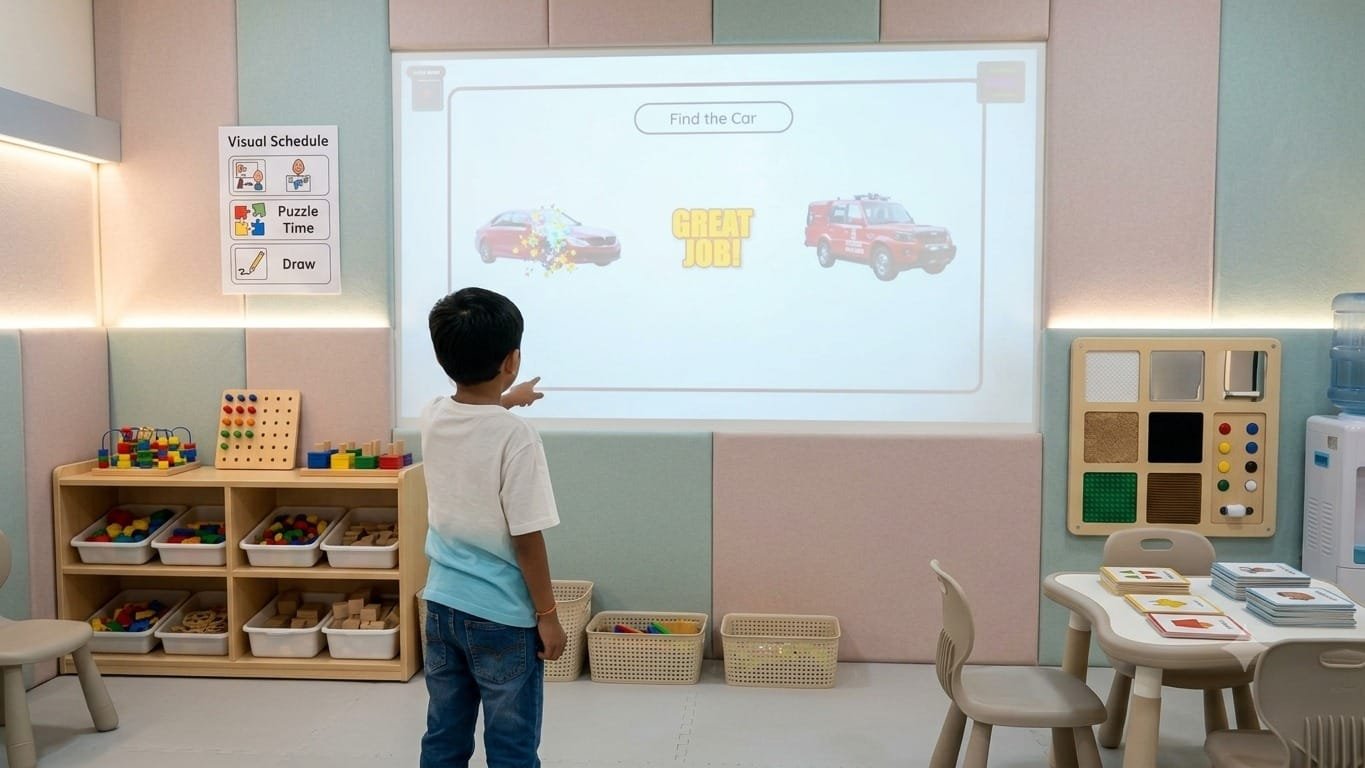
Find the match, hold the rule in mind, do it again when the rule changes.
What it is
A projected game the child plays by pointing, reaching or selecting, with a camera reading what they choose. The tasks are cognitive rather than physical: find the matching shape, remember which one was hidden, repeat a sequence back, sort by a rule that changes partway through.
Where the other activities put the demand in the body, this one puts it in attention and working memory. The movement is incidental — the work is noticing, holding something in mind, and acting on it.
Why it holds attention
Cognitive tasks are the easiest for a child to disengage from, because failure is invisible and progress is abstract. A game makes both concrete: the match either lands or it does not, the sequence either completes or resets. Children who find table-top cognitive work discouraging will often keep going when the feedback is immediate and nobody is watching them write anything down.
What the therapist controls
The number of items on screen, how long a prompt stays visible, how quickly the rule changes and how much the game helps are all adjustable. Start with two choices and generous time; narrow both as the child succeeds.
What it works on
Sustained attention
Staying with a task long enough to finish it, not just to start it.
Working memory
Holding a rule or a sequence in mind while acting on something else.
Matching & sorting
Recognising sameness and difference by colour, shape or category.
Following instructions
Acting on a visual prompt — useful where verbal instruction is hard to process.
In the room
-
01
Pick the skill
Choose whether the session is working on attention, memory, matching or rule-switching.
-
02
Set the load
Begin with few items and long prompts so the first attempts succeed, then reduce both.
-
03
Change the rule
Switching the sorting rule partway through is where flexibility gets practised rather than assumed.
-
04
Review accuracy
Attempts, accuracy and time on task are recorded, so trends are visible across weeks rather than guessed at.
Eight modules, one system
Most clinics start with the two that match their most common goals, and add more once the team is comfortable.