

Balance Board
A tilting platform the child controls with their own body weight — core stability and postural control work that feels like steering a car.
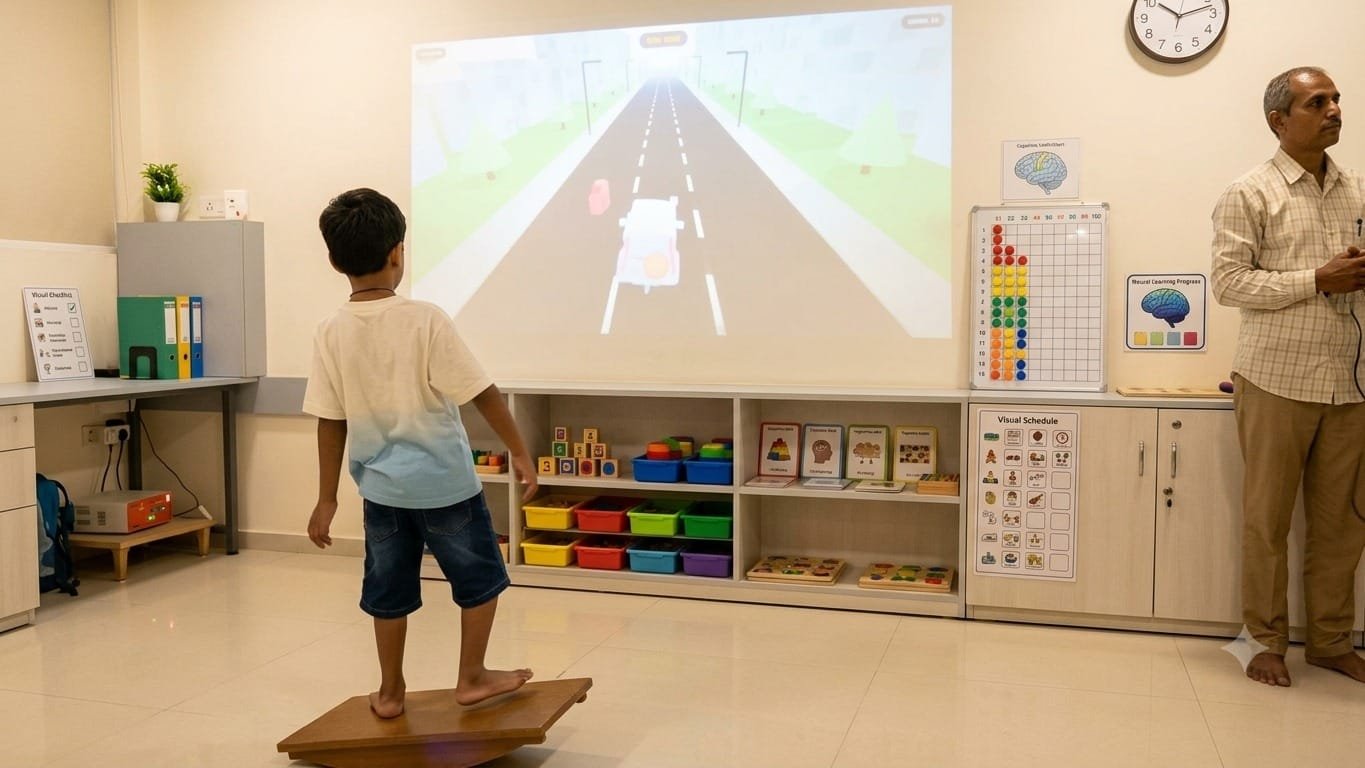
The child shifts their weight to steer. The therapist watches posture, not the scoreboard.
What it is
The child stands on a tilting platform in front of a projected game. Leaning forward, back or to either side moves the game — most often a vehicle along a road, but the same mechanic drives several activities. To keep the car on the road they have to find and hold their midline, make small continuous corrections, and recover when they overshoot.
That is postural control work. It is the same demand a therapist creates with a wobble board and a verbal count, with one difference: the child is concentrating on the road, so the corrections keep coming long after a counted exercise would have ended.
Why it holds attention
Balance work is hard to make interesting. There is no obvious goal, progress is invisible from the inside, and the effort is constant. Attaching it to a game supplies all three: somewhere to get to, a visible result for every correction, and a reason to try again after a wobble.
What the therapist controls
Sensitivity, speed and how much tilt is needed to turn are all adjustable, so the same activity suits a child working on static standing tolerance and one working on dynamic reactions. You can widen the road to build confidence early in a session, then narrow it as they warm up.
What it works on
Core stability
Sustained trunk engagement to stay upright on an unstable surface.
Postural control
Continuous small corrections rather than a held position.
Body awareness
Learning where midline is, and what it feels like to return to it.
Weight shift
Controlled, deliberate loading through each side in turn.
In the room
-
01
Set the board up
The platform sits facing the projection, within the therapist's reach. Children who need it start with a hand on a support or the therapist's arm.
-
02
Calibrate to the child
Set how much tilt produces how much turn. A child with limited control gets a forgiving setting so early attempts succeed.
-
03
Play, and progress mid-session
As they settle, narrow the road or raise the speed. The challenge tracks the child rather than a preset level.
-
04
Review what happened
Time on task and attempts are recorded as they play, ready for the notes and for the parent at the door.
Eight modules, one system
Most clinics start with the two that match their most common goals, and add more once the team is comfortable.