

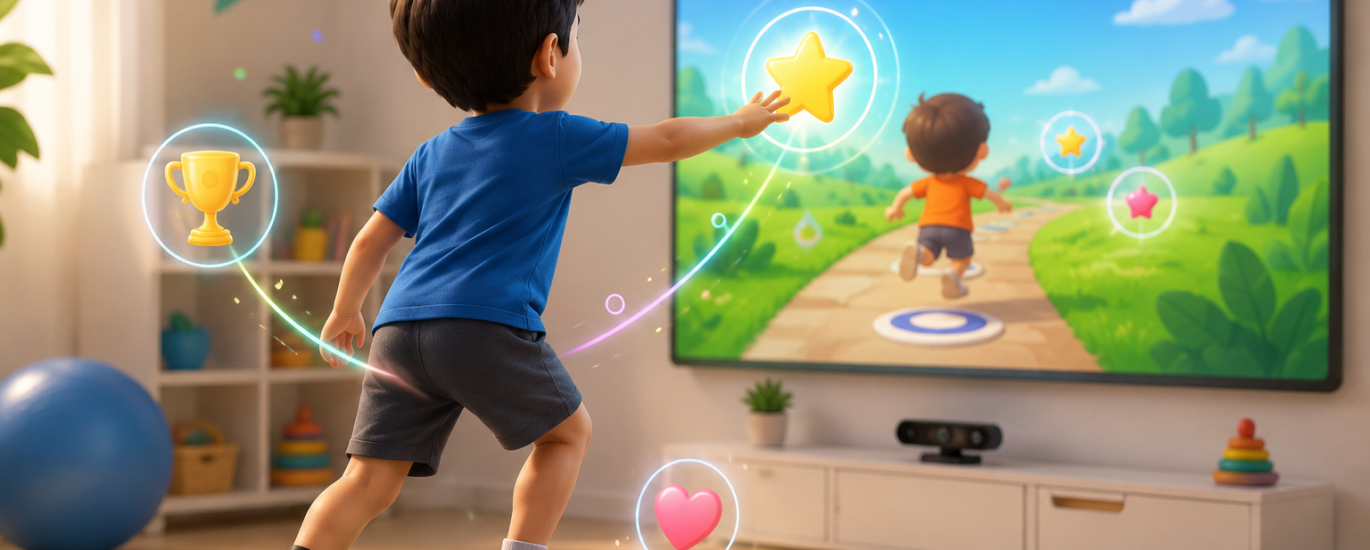
For many children, therapy can sometimes feel repetitive or difficult. Exercises that are important for physical development may not always be activities that children naturally want to do.
This is where interactive gaming can make a meaningful difference.
By combining therapeutic exercises with games, movement, challenges, rewards, and visual feedback, therapy can become an experience that children are more excited to participate in.
Why Engagement Matters in Children’s Therapy
Successful therapy isn’t only about choosing the right exercises. Participation matters too.
When a child is interested in an activity, they are more likely to pay attention, participate, repeat movements, and stay motivated throughout a session.
Traditional exercises can sometimes make this challenging because children may not immediately understand the purpose of repeating a movement.
Gaming introduces something children already understand:
A goal. A challenge. An action. A reward.
Instead of simply completing an exercise, the child can become part of an interactive experience.
Turning Exercises Into Games
Imagine asking a child to repeatedly raise their arm.
Now imagine that the same movement helps a character collect a star on the screen.
The physical movement hasn’t necessarily changed—but the experience has.
Therapeutic movements can become part of activities such as:
Reaching for virtual objects
Following an on-screen character
Stepping on targets
Balancing to control a game
Moving around obstacles
Collecting stars or rewards
Completing simple challenges
Progressing through different game levels
The child focuses on completing the game, while the therapist can focus on the underlying therapeutic objective.
1. Games Can Capture Attention
Children are naturally drawn to colorful visuals, movement, sounds, characters, and interactive challenges.
A game can provide continuous visual feedback that helps maintain attention during an activity.
For example, when a child moves their hand toward a target and sees the target respond immediately, the movement becomes more meaningful and rewarding.
2. Rewards Can Encourage Participation
Small rewards can make a big difference in motivation.
A child might earn:
⭐ Stars
🏆 Badges
🎯 Points
🎮 New Levels
✨ Celebrations
These rewards don’t have to be complicated.
Sometimes seeing a character celebrate or watching a progress bar increase can be enough to encourage a child to try again.
3. Children Can Learn by Following
Some children respond better to visual instructions than to verbal instructions alone.
Interactive games can demonstrate what a child needs to do.
For example:
Watch → Follow → Complete → Celebrate → Repeat
An animated character can demonstrate a movement while the child attempts to copy it.
This approach can make instructions easier to understand and turn learning into an active experience.
4. Immediate Feedback Makes Progress Visible
One challenge with traditional exercises is that improvement may not always be immediately visible to a child.
Games can provide instant feedback.
A child can see:
A target being reached
A level being completed
A score increasing
A star being collected
A progress bar moving forward
A new achievement being unlocked
This creates a simple connection between effort and achievement.
5. Games Can Make Repetition More Enjoyable
Repetition is often an important part of learning physical movements.
But repeating the same movement doesn’t have to mean experiencing the same activity.
A game can change the environment, challenge, character, objective, or reward while encouraging similar therapeutic movements.
For example, the same reaching movement could be used to:
Catch butterflies → Collect stars → Pop bubbles → Pick fruit → Help a character
The therapeutic objective can remain consistent while the activity feels fresh.
6. Gaming Can Encourage Confidence
Children may become frustrated when they struggle with an exercise.
Game-based experiences can provide frequent opportunities for small successes.
Completing a simple challenge can give a child the feeling:
“I did it!”
Those small moments of achievement can help create confidence and encourage children to keep trying.
Gaming Doesn’t Replace the Therapist
Interactive therapy technology should not be viewed as a replacement for professional therapists.
Instead, it can be a tool that supports therapists.
The therapist remains responsible for understanding the child’s needs, selecting appropriate activities, adjusting difficulty, and guiding the therapy process.
Technology can help make those activities more interactive and engaging.
A Child-Centered Approach to Therapy
Every child is different.
Some children may enjoy movement-based games. Others may prefer visual challenges, simple matching activities, music, characters, or reward-based experiences.
The goal is not simply to make therapy look like a video game.
The goal is to create meaningful interaction around therapeutic activities.
When children enjoy what they are doing, therapy can become something they actively participate in rather than something they simply have to complete.
How NoPainHeals Uses Play to Support Therapy
At NoPainHeals, we are creating interactive games specifically for therapy.
Our approach combines:
Play + Movement + Learning + Interaction + Progress
We want children to be able to follow movements, participate in activities, complete challenges, and celebrate their achievements while therapists work toward meaningful therapeutic goals.
Our vision is simple:
Make therapy something children want to do.
The Future of Children’s Therapy Can Be More Interactive
Technology gives us an opportunity to rethink how children experience therapy.
Instead of asking:
“How can we make children complete this exercise?”
We can also ask:
“How can we make this exercise something they want to play?”
That shift can open the door to more engaging experiences for children, more interactive sessions for therapists, and a more positive approach to therapeutic practice.
At NoPainHeals, we believe that play can be a powerful part of the therapy journey.