

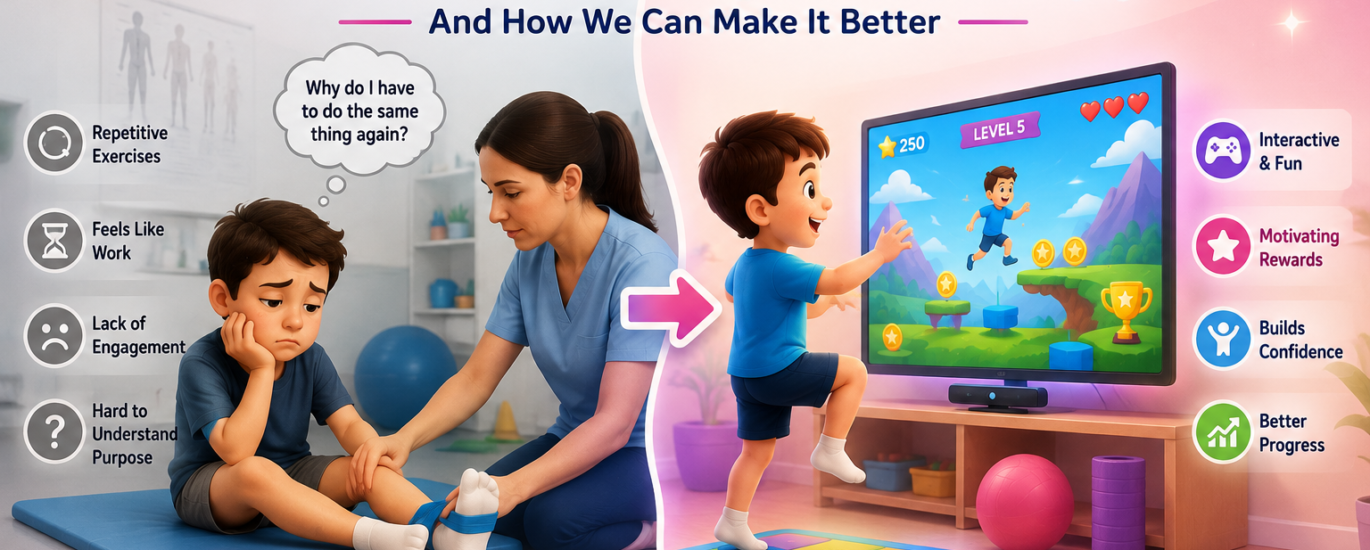
For many children, physiotherapy can be an important part of building strength, coordination, balance, mobility, and independence. But getting a child to participate consistently can sometimes be challenging.
The exercises may be repetitive. Some movements may feel difficult or uncomfortable. Sitting through a session can feel like work rather than play. And when a child loses interest, it becomes harder for therapists and parents to maintain consistent participation.
What if therapy could feel less like an exercise session and more like a game?
That is the idea behind a new approach to pediatric therapy: turning therapeutic movements into interactive, engaging experiences that children want to participate in.
Why Traditional Physiotherapy Can Be Challenging for Children
Traditional physiotherapy often involves repeating specific movements or exercises to achieve therapeutic goals. While repetition is important for learning and physical development, children may not always understand why they need to repeat the same movement.
Here are some common reasons children may find traditional physiotherapy difficult or boring.
1. Repetitive Exercises Can Feel Boring
Children naturally enjoy variety, exploration, and play. Performing the same exercise repeatedly can quickly become monotonous.
For example, a therapist may ask a child to perform a particular movement several times to improve coordination or strength. Although the exercise may be therapeutically valuable, the child may simply see it as a repetitive task.
When an activity feels boring, maintaining attention and participation can become difficult.
2. Therapy Can Feel Like Work Instead of Play
Children learn naturally through play.
When therapy feels very structured or instructional, some children may become less motivated to participate. They may prefer activities where they can explore, make choices, receive rewards, and experience a sense of achievement.
Transforming exercises into playful activities can help create a more positive therapy experience.
3. Difficult Movements Can Create Frustration
Some therapeutic movements require effort, balance, coordination, or concentration.
When a child finds an exercise difficult, repeated unsuccessful attempts can lead to frustration. The child may lose confidence or become reluctant to try again.
Providing immediate encouragement and celebrating small achievements can help children stay motivated.
4. Children Have Different Attention Spans
Every child is different.
Some children may participate comfortably for longer periods, while others need frequent changes in activity to remain engaged.
For children who find it difficult to maintain attention, interactive visual and game-based activities can provide additional stimulation and clear goals.
5. Children May Not Understand the Purpose of an Exercise
Adults understand that repeating an exercise today may help improve a physical skill over time.
Children may not think that way.
They may simply wonder:
“Why do I have to do this again?”
Games can provide an immediate purpose. Instead of asking a child to repeatedly move their arm, leg, or body, the movement can become part of a challenge—such as reaching a target, collecting stars, completing a level, or helping a character finish an adventure.
The child focuses on playing, while the therapeutic movement becomes part of the experience.
Can Technology Make Physiotherapy More Engaging?
Technology has changed the way children learn, communicate, and interact with the world.
Interactive gaming can bring some of those same principles into therapy.
Instead of simply performing an exercise, a child can interact with a visual game that responds to their movements.
For example:
Reach → Hit a target → Earn a reward → Complete a challenge → Move to the next level
The therapeutic movement becomes part of the game.
This can make the activity feel more purposeful and enjoyable while still allowing therapists to work toward specific therapeutic goals.
The Power of “Follow, Play, Learn”
One of the key ideas behind game-based therapy is making instructions easier for children to understand.
Instead of giving only verbal instructions, interactive games can demonstrate movements visually.
A child can:
Watch a movement
Follow the movement
Receive immediate feedback
Complete a challenge
Celebrate the achievement
Try the next activity
This “follow and learn” approach can make activities easier to understand and more engaging.
Small Achievements Can Build Motivation
Children respond naturally to positive reinforcement.
A simple star, badge, score, animation, or encouraging message can turn a difficult activity into a moment of achievement.
Instead of focusing only on whether an exercise was completed perfectly, interactive therapy can help children recognize progress:
“I did it!”
That feeling of success can encourage children to try again.
Over time, small achievements can help create a more positive relationship with therapy.
Making Therapy Enjoyable Doesn’t Mean Making It Less Therapeutic
An important point is that fun and therapy do not have to compete with each other.
The goal isn’t to remove therapeutic exercises.
The goal is to present them in a way that makes children more willing to participate.
A game can be designed around therapeutic objectives such as:
Balance
Coordination
Range of movement
Motor skills
Body awareness
Reaction and response
Following instructions
Reaching and movement
Repetition and practice
The therapist remains focused on the therapeutic objective, while the child experiences an engaging activity.
Where NoPainHeals Comes In
At NoPainHeals, we believe children shouldn’t have to choose between therapy and fun.
We are creating interactive games for therapy that help children follow, learn, move, and participate through engaging digital experiences.
Our goal is simple:
Turn therapeutic exercises into experiences children want to play.
By combining therapeutic activities with interactive gaming, visual guidance, challenges, rewards, and progress-focused experiences, NoPainHeals aims to help make physiotherapy and occupational therapy more engaging for children.
A Different Way to Think About Pediatric Therapy
Instead of:
“Do this exercise 10 times.”
Imagine:
“Can you collect all five stars?”
Instead of:
“Stand here and maintain your balance.”
Imagine:
“Can you stay on the magic island without falling?”
Instead of:
“Follow this movement.”
Imagine:
“Can you copy the character and complete the challenge?”
The therapeutic goal can remain the same.
But the child’s experience can be completely different.
Every Child Deserves an Engaging Therapy Experience
Physiotherapy can play an important role in helping children develop physical skills and greater independence. But participation matters—and keeping children motivated can sometimes be one of the biggest challenges.
By bringing together therapy, technology, movement, and play, we can create experiences that encourage children to participate while supporting therapists in their work.
At NoPainHeals, we’re working toward a future where therapy doesn’t have to feel like something children simply have to do.
It can be something they look forward to.
NoPainHeals — Creating Games for Therapy
Play. Follow. Learn. Move. Grow.